Showing posts with label william morris society. Show all posts

Tuesday, 27 January 2015

new Chants shows

we've got three new shows coming up, they are pretty special, extremely intimate, and in William Morris's houses!

getting tickets is pretty old school, here are the details

Saturday 7th Feb, from 2:15
William Morris Society & Museum, Kelmscott House, 26 Upper Mall, Hammersmith, W6 9TA

Setting Morris’s Lyrics to New Music

Darren will sing the songs acoustically, talk briefly and hold a Q&A session.

• Tickets: members, £6; non-members, £8; students £4

Applications for tickets should be sent to the WMS office (address above)
Stamped addressed envelopes should accompany all postal bookings.

The pre-booking of tickets for all events is strongly advised. Our historic Coach House lecture room has limited seating capacity and if you attend without booking beforehand you risk being turned away.


Thursday 19th and Friday 20th March, from 7:30
William Morris Gallery, Lloyd Park, Forest Road, Walthamstow, London, E17 4PP

Darren Hayman performs Chants for Socialists


•  Advance tickets only £12

tickets will go on sale at the Gallery tomorrow (28th Jan) morning at 10am, either in person or over the phone (020 8496 4390)

Friday, 16 January 2015

Sunday, 5 October 2014

hand printing sleeves

we had a very busy day yesterday hand-printing 425 of the 500 sleeves for the vinyl edition of the album

thanks so much to everyone that helped, and to the William Morris society who let us take over their room and press for a day

lots of photos will follow, but for the mean time:

Friday, 3 October 2014

Ten Strikes

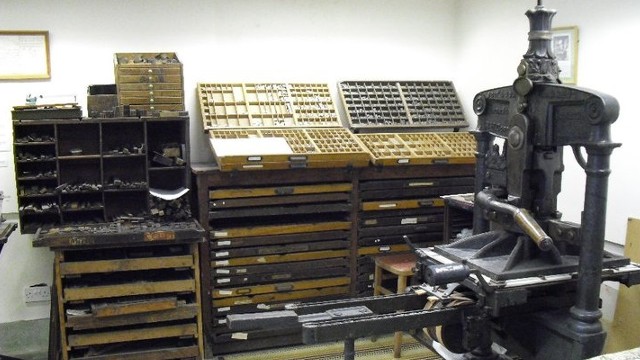
we're going into Kelmscott House tomorrow to hand print the vinyl sleeves on William Morris' Albion Press


equally excited and nervous:


Ten Strikes
by Tim Hopkins, part-time printer

1. What’s the greatest work of art in history? In the 1980s, I’d have been very happy with the idea that it was the 7” of “Ever Fallen In Love (With Someone You Shouldn’t’ve)” by Buzzcocks. I might even have said so, had I been smart enough. These days I’d dispute the terms of the question.

2. I spend most of my working life creating electronic documents, typing words so they show up on a screen. A success is creating a file worth loading onto something called SharePoint, a great success might get sent to a laser printer, or ten laser printers. In my spare time, amongst other things, I am a letterpress printer: I arrange type or printing blocks to form a raised surface which, when inked and pressed on paper, makes indelible marks on a tangible object.

3. William Morris’s socialism was based on making: he knew the workers would be well-served by owning the means of production but he took that further and more literally than most: he believed that human happiness would be achieved when all of us were engaged in crafting the things we needed as a society. He hated the quality of mass-produced goods, but he also hated the effect mass-production had on people, believed it alienated people from the satisfaction of craft.

4. The press I mostly use at home is called an “Adana Eight-Five”. It sits comfortably on a table-top. Talk to a proper printer and they are likely to be a bit sniffy about a press like mine. “Hobby kit”, they are likely to say. Some younger professional printers seem bemused and delighted that anyone would bother typesetting and printing by hand, given how inefficient it is.

5. William Morris designed, wrote, drew, wove, translated, carved and also printed. He used his press to make some of the most breathtaking printed materials - have a look at The Kelmscott Chaucer sometime - as well as political pamphlets. The Albion Press he used is still there in Kelmscott House in Hammersmith. You can go and have a look at it; it’s beautiful and looks robust enough to last forever.

6. Fine printing - high-value, high-skill, beautiful letterpress work, has been around since it became possible to use printing as an efficient alternative to monks and scribes. There was another sort of letterpress, though, a more everyday kind of work. Business cards, dance cards, handbills, lots of stuff. It was rendered irrelevant by technological advance, of course: various kinds of lithography, photocopying eventually. Electronic communication, of course. It’s almost gone now, though there remains a smallish “craft letterpress” world, mostly amateur. Some people even make their living by craft letterpress - wedding stuff is the big moneyspinner, apparently.

7.  This record cover is made of 280gsm paper (“Context Cream”), supplied by Paperback Paper in Beckton.  The design and layout was by John Jervis. This section, inside the sleeve, was laser printed by Footprint Workers Co-operative in Leeds. The flower images, after Morris’s designs, were made into polymer printing blocks by PeacockBlockmaking of Berkhamsted; the text on the outside of the sleeve is hand-set using 32 point Centaur italic type from the Kelmscott House collection. It was hand-inked using “warm red” Van Son rubber-based ink and printed by hand on the Kelmscott Press.

8. William Morris was troubled by the fact that only the rich could afford to buy the amazing things produced by properly-paid artisans in his workshops. Later followers worked out how to make his style, or something like it, much more widely available: by using the mass production techniques Morris hated. The stuff which ordinary people could afford was better; the problem of alienation perhaps less so.

9. Walter Benjamin famously worried about what happens to art when it’s mass-reproduced: he reckoned that an original work of art had an aura, derived from being in a time and place, which a mechanical reproduction could never have. He was talking about visual art rather than music. But I understand  very well that it’s the 7” of “Ever Fallen In Love” which is the perfect piece, and I don’t care how it was made, or that there’s no chance that any Buzzcock even clapped eyes on my copy.


10. Vinyl records are made by making an impression with a “stamper” into softened plastic. As a process, it’s not so different to letterpress. Both, too, are tiny niches left over from past mass markets. They are both more or less obsolete technology, but loved and valued as such. The package in your hand is mechanically mass-produced but also hand-made, or at least hand-finished. It really cannot decide whether it’s artisanal or mass-market, professional or amateur. I can’t work out whether that matters.

Monday, 25 August 2014

Chants for Socialists (after William Morris)

"...there's an album about girls and sex and stuff... or, I'm putting William Morris's Chants for Socialists to music."

How could I resist?...

Now, I don't know if you've ever released an album by Darren Hayman (the majority of London's independent record labels have), or even heard one (in 1996 he formed a band called Hefner, then a band called the French in 2002, and has been recording under his own name since 2006) but they are always amazing things to be involved with. They are like the best school projects that go on into the holidays because you are loving to learn with your new friends. There is always more to find out, more questions to ask, and more ideas to embrace.

So, with this in mind, we sat in a Walthamstow pub talking about William Morris, and how we could release an album of 19th century chants and make it both relevant in the 21st century, and true to Morris' ideas. We boiled it down to three points:

"I do not want art for a few any more than education for a few, or freedom for a few."
- We had to make the music available to everyone, allowing anyone who wanted to listen to pay what they could afford or felt it was worth.

"Have nothing in your house that you do not know to be useful, or believe to be beautiful."
- This couldn't just be your bog standard CD-with-a-picture-of-the-band-on-the-front. We would include a booklet with the physical release, and ask experts for short essays. Darren would illustrate each track. We would make both the sleeve and record itself (yes, a vinyl record!) so remarkable that people who have moved their turntables to the loft (shame on you) could still enjoy the 12" square and circle.

"To give people pleasure in the things they must perforce use, that is one great office of decoration; to give people pleasure in the things they must perforce make, that is the other use of it."
- The means of production is all important. We would hand make whatever we could, asking favours (to be returned) of friends with expertise or eagerness to learn, or simply enjoyment of their craft. People who love to sing would be in the choir, people who loved to play would be in the band and people who loved to print would put the cover together

All nicely summed up by the great man:

"... we may adorn life with the pleasure of cheerfully buying goods at their due price; with the pleasure of selling goods that we could be proud of both for fair price and fair workmanship: with the pleasure of working soundly and without haste at making goods that we could be proud of"

Comforted that we weren't going to betray too many of his philosophies, we also wanted a link to Morris - some context to the recordings, so we sent some emails....

- the William Morris Gallery in Walthamstow kindly opened their doors one evening to let us record a choir (of "left-leaning locals") in the house he grew up in.
- the William Morris Society generously opened up at 9 one Saturday morning for us to record nine female singers in the room Bernard Shaw lectured, and Gustav Holst conducted the Hammersmith Socialist Choir.
- and Kelmscott Manor allowed Darren to play William Morris' piano (very gently).

So here we are, at the end of the summer, with an album recorded and hundreds of people to thank (especially Helen Elletson, Rebecca Jacobs and Kathy Haslam). We'll be busy putting the whole thing together over the next few months, and you can keep track of our progress here

http://chantsforsocialists.blogspot.co.uk

I wonder what happened to that album about girls and sex and stuff...

“If a chap can't compose an epic poem while he's weaving tapestry, he had better shut up; he'll never do any good at all.”

Wednesday, 21 May 2014

badges for singers

next week we're doing some recording at the William Morris Gallery (Wednesday) and the William Morris Society (Saturday) and we've made some badges for our guest singers - a different design for each day:


Monday, 19 May 2014